The Journey Starts….
To escape the chaos of Bengaluru, I always make it a point to leave home before dawn. Getting caught in traffic right at the start of a trip is like swallowing a bitter pill. This time too, I stuck to my routine. I was on the road by 4 a.m. sharp, along with my friend Karthik. We had to pick up a friend who was arriving from Ernakulam by train. His train was scheduled to reach Krishnarajapuram Railway Station early in the morning, and for once, the Indian Railways managed to surprise us, the train was right on time!
Bengaluru was still half asleep. Only a few tea stalls and tiny eateries were open. The monsoon chill hung in the air, and in the yellow glow of dim bulbs, a few men sipped steaming cups of tea, perhaps workers heading early to their jobs, perhaps wanderers who hadn’t slept yet. Watching them always evokes a strange sadness in me. While some of us set out on journeys to celebrate life, others start their day battling it for survival. Life, after all, plays by its own rules.We met quickly at the station and were soon on our way out of the city. Every minute in Bengaluru counts, so crossing the Nelamangala toll within an hour felt like a small victory. From there, it was time to relax, to leave behind the city’s restlessness and soak in the calm of the countryside.
We stopped at a small roadside tea stall along the highway. The world was still dark. A lone man, sitting under the soft glow of a yellow bulb, was boiling tea in an old aluminum pot. Everyone ordered a cup. Those who’ve tasted tea in Karnataka know it’s not quite like what we get back home in Kerala. Half the quantity, twice the thickness, and always boiled to perfection. Over time, I’ve grown to love it.
By the time we reached Hassan, the sun was out. It peeked shyly through layers of drifting clouds. Hunger started to grow in our tummies. It was still before 7 a.m., but we decided to try our luck at the familiar Adyar Ananda Bhavan we used to visit on earlier trips. Luck was on our side. The place was already open! After a hearty breakfast of dosa, ghee pongal, and podi idli, both heart and stomach were full. It takes roughly a little over two hours to reach Hassan town from the Nelamangala toll. Hassan is the gateway town to the Malnad region for those coming from the Bangalore side.
Hassan town was slowly waking up. We passed morning joggers, sanitation workers sweeping the streets, and office-goers heading to work. Soon, we took the Belur road, a single route winding through the heart of rural Karnataka. The landscape changed dramatically with long stretches of paddy fields, patches of maize, sugarcane, cotton, and even fields of flowers.
Belur appeared next, home to the famous Chennakesava Temple, a UNESCO World Heritage Site. Having visited it before, we decided to skip it this time, maybe on the next trip.A little beyond Belur, we turned toward Kalasa and Sringeri, and the scenery began to shift again. Coffee estates started to appear, wrapping the hills in endless green. The weather turned cooler; mist and light drizzle accompanied us as we climbed higher. Solitary houses appeared here and there, surrounded by coffee and pepper vines. Lower down, coconut and areca palms reminded us of home. In fact, this part of Karnataka feels strikingly similar to Kerala, the people, the food, even the rhythm of life.
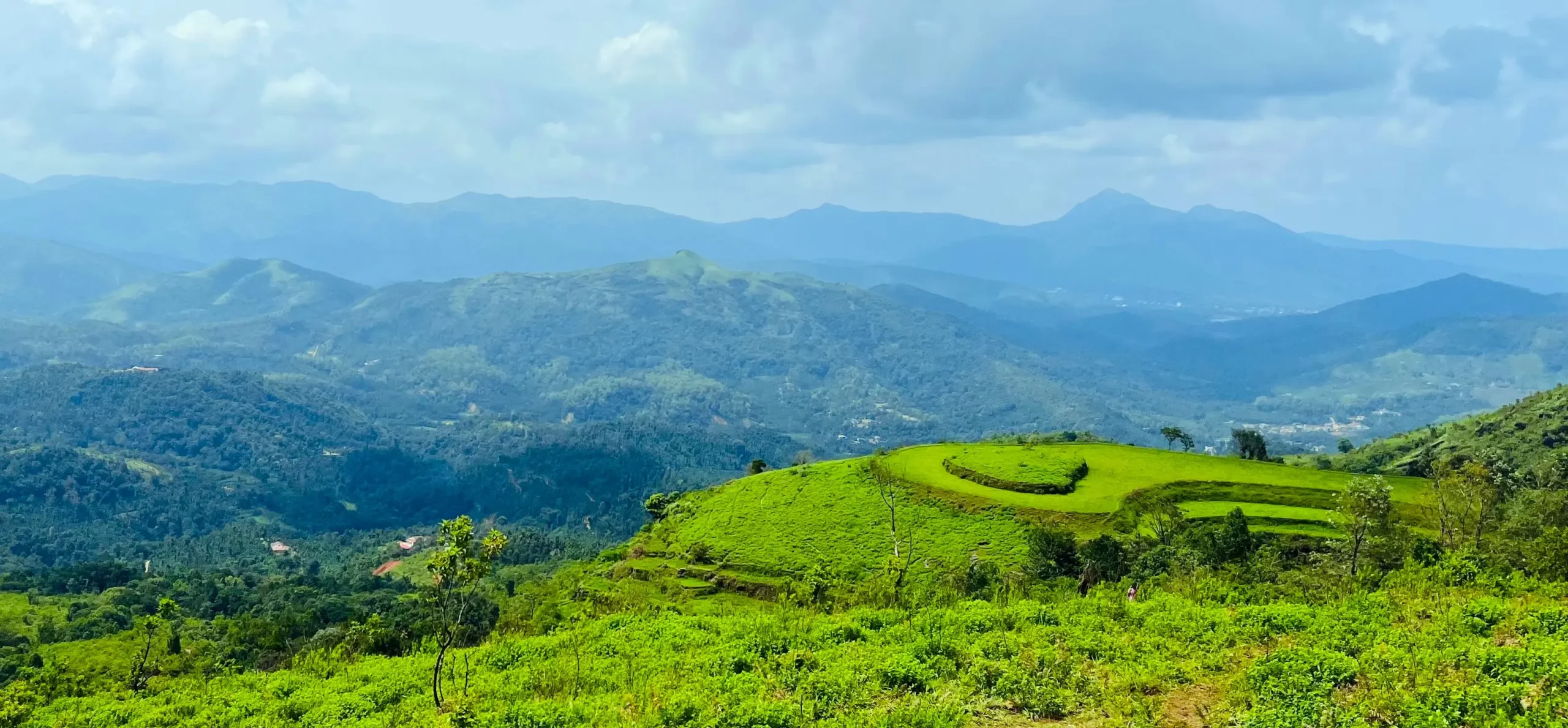
We stopped once more, this time for a strong filter coffee. After all, we were now in Chikmagalur, the land of coffee. With cameras in hand, we captured the lush scenery along the way. We proceeded further into the heart of Chikmagalur District. Tea gardens slowly replaced coffee estates, and we began to experience the Western Ghats in all their glory, with occasional rains along the way.
We paused near a small river, watching it flow past a check dam, the foam swirling as the water rushed downstream. Across the river, tea plantations climbed the slopes, and a hanging bridge swung gently in the breeze. A perfect spot to stop and breathe in the calm beauty of nature.
After crossing Samse, often called the base village for Netravathi Peak, we reached a small town called Mullodi. From there, we deviated toward our stay, from where we planned to explore the region. The road leads to the famous Bamikonda Viewpoint where we could see one side of the lovely Kudremukha Ranges.
We booked a cozy homestay perched on a hillside, away from the noise of the main road. It was exactly what we wanted, simple, quiet, and surrounded by nature. During the monsoon, these roads turn to mud tracks, passable only by 4×4 vehicles. Luckily, our Jimny was more than ready for the task.
A rough 3 to 4 km climb through slushy, rocky paths brought us to the homestay. It was clean, comfortable, and had the basic facilities we needed. We had booked a private room for six, with an attached bathroom, simple but perfect. After a hearty traditional lunch of rice, sambar, rasam, and vegetables, the rain began again and never stopped until dinner time. We were a little apprehensive about the next day’s plan. The excessive rain could ruin our trek if the water levels rose at the numerous river crossings along the way to Netravathi Peak. The forest officials would close the trek path without a second thought. Nonetheless, despite the worry, the rhythm of the falling rain lulled us to sleep, a lullaby only the mountains can sing.
Trek Day: The Ascent to Netravathi Peak
This was the day we had been waiting for, the trek to Netravathi Peak.
Stepping out early in the morning, we were greeted by a breathtaking sight, clouds draped across the hills, mist flowing gently through the valleys, and the calls of unseen birds echoing in the air. The sun appeared briefly, scattering silver light across the wet leaves before hiding again behind the clouds.
After breakfast, we drove back to Samse to buy a few essentials, water bottles, fruits, peanuts, and some sweets. From Samse, one needs a proper off-road jeep to reach the Netravathi base camp, about 4 to 5 km away through mud and streams. During summer, big vehicles can manage, but in the monsoon, only 4x4s can get through. The jeep drivers charge around ₹500 per person for a round trip, mostly using Bolero Campers. We saw numerous Mahindra Jeeps and Campers plying toward the peak base camp, full of trekkers. We were a little relieved that the trek was open that day. We had to fill out a form and hand it over to the forest officials before entering the trek. All shops in Samse provide these forms, which you can fill out and proceed to the base camp with. There is no digital copy system here, you need to take a printout of the booking confirmation to submit at the forest check post, where you will be assigned a guide. No need to hire one separately. But be mindful that a guide is mandatory for the trek; you cannot go on your own.
With our Jimny ready for anything, we followed the jeeps up the rugged road. A few drivers gave us skeptical looks, private vehicles are not exactly welcome competition. But we ignored the glances and carried on. The views along the way were mesmerizing, mist-covered coffee estates, small waterfalls cutting across the road, and the constant whisper of rain.
At one point, some jeep drivers tried to warn us: “The road ahead is too bad for your car. Give us ₹500, and we will take you.” But after coming this far, we were not about to back down. The last stretch was indeed rough, a few bumps and scrapes, but our Jimny made it without trouble. From the parking area, it was a short five-minute walk to the forest check post. The time was 10:45 a.m. Make sure you reach before 11 AM. They won’t allow anyone after 11 PM to the peak. We quickened our pace, handed over our booking slips, registered our names, and were soon assigned a guide, Sankre Gowdru, a gentle man with kind eyes and the number 61 on his tag, meaning we were the 61st group of the day.
The forest officials checked our bags to ensure we carried no plastic, alcohol, cigarettes, or drones. A camera fee of ₹350 was collected, and then we were ready to begin. The trail started with a gentle climb but soon we were engulfed in thick fog, so dense that even the person ten feet ahead disappeared into white. Walking through that misty forest was a surreal experience. Soon, we began to hear the faint rush of water, growing louder as we climbed. The trail to Netravathi Peak is dotted with waterfalls and streams, many of them visible only during the monsoon.
Our guide told us that the Netravathi River, one of Karnataka’s lifelines, originates from these very hills. We crossed a beautiful waterfall using ropes tied by the forest staff to help trekkers during the rains. The water was crystal clear and icy cold, pure enough to drink. Rain came and went in intervals. Mist rolled in waves. The ascent grew steeper, and exhaustion began to set in. Still, the views were worth every drop of sweat, rolling green ridges fading into the clouds, the smell of wet earth, and the sound of unseen streams rushing through the forest.
After one to two hours of moderately easy ups and downs, we reached the final river crossing and waterfall. From here, the trek difficulty drastically changes from moderate to difficult. People with any sort of respiratory illness or disabilities are not advised to do this trek. The last part of the climb is steep and unforgiving on the body. But slow wins the race. Take your time, rest, and enjoy the surrounding vastness of green meadows and the journey of clouds across the valleys. Slowly, you can make it to the top. Once you cross one hill, another appears, as if there is no end to it. But after two to three summits, you will reach Netravathi Peak.
Finally, after a few steep climbs, we reached the summit. The top was alive with energy, trekkers laughing, taking pictures, sharing food, and simply soaking in the view. Some sat quietly, lost in the vastness around them. The panorama stretched endlessly, a 360-degree canvas of mountains, clouds, and mist.
We had our packed lunch at the top. Usually, all the homestays provide packed lunches for trekkers heading to Netravathi Peak or any nearby trails, which you can carry along with your belongings. Be a responsible traveller and make sure you do not litter, not even food waste. After lunch, the crowd started to descend. We rested a while and waited for the crowd to thin. When the fog rolled back in, wrapping the peak in white, we knew it was time to head down.
We stopped briefly near the waterfall again, now calmer as the rush of trekkers had passed, and enjoyed a few more moments of peace before heading down. By the time we reached our homestay, dusk had settled over the hills. Exhausted but content, we ate a simple dinner and drifted into sleep, the rain still whispering softly outside.
Every journey teaches something.
This one reminded me how nature humbles us, how small we are among these ancient mountains, and how rewarding it is to step away from the noise and simply listen. The trek to Netravathi Peak was not just a climb; it was a reminder of the quiet beauty that still exists, if only we rise early enough to find it.
How to Book:
The trek can be booked via https://aranyavihaara.karnataka.gov.in/
- You can book any trek in Karnataka controlled by the government through this website.
- Select the District as Chikmagalur and the trek as Netravathi Trek.
- Select the dates and pay the fee of ₹500 (as of Sep 2025). You can pay the amount online and take a printout of the booking confirmation.
Where to Stay:
We stayed at a place called Girimane Homestay, which is a little ahead of Samse village on the way to Bamikonda Peak. But you can find plenty of homestays near Samse village, Mullodi village area, and near the base camp. Camping facilities are also available in most of the homestays.
Nearest towns: Kalasa and Chikmagalur.
Things to Carry:
- 1 literof water per person
- Lunch and snacks (no plastic wraps)
- Booking confirmation printout
- Raincoat
- A good pair of trekking shoes is recommended
- Leech repellent
- Sunscreen and a hat to protect from harsh sun rays
- Cash for camera fee, jeep charges, and guide fee as there is no ATM or proper network nearby
Things ‘NOT’ to Carry:
- No drones are allowed
- No plastic
- No cigarettes or lighters
- No alcohol
Here is a video of our Netravati Peak trek (Audio is in Malayalam with English Subtitles )